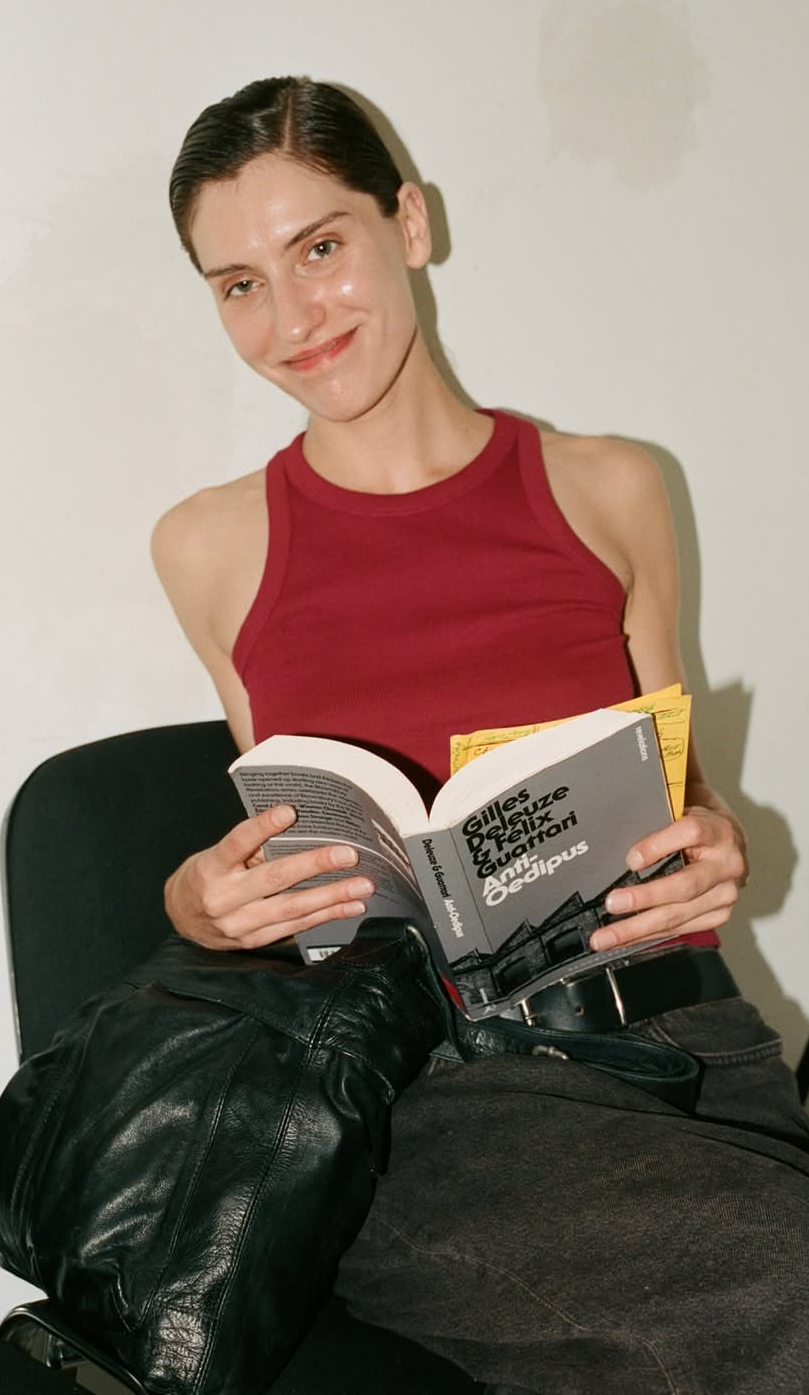
Di Yehorova is an interdisciplinary researcher, writer, and documentary producer interested in temporality, rupture, and the politics of space. Their work engages with counter-cartographic approaches, speculative geographies, and topological readings of loss and love.
Di holds an MSc in Global Development from the University of Copenhagen and previously studied international relations and regional studies at the Institute of International Relations in Kyiv, Ukraine. Their master’s thesis explored the temporal dimensions of queer resistance during Russia’s full-scale invasion of Ukraine. Findings from the thesis gave shape to a policy brief published by the Danish Institute for International Studies (DIIS). Di is also a co-founder of Occupational Formations: Infrastructure of the Seen and Unseen, a para-academic research network examining Russia’s ongoing occupation of Ukrainian territories.
Research summary: Temporality, the constuctedness of narratives, and the surrounding environments and emerging infrastructures—particularly those that may be framed as affective, and those that resist capture through their opaqueness—are precisely what interest me. Well before I discovered the terminology and grasped the registers of the language I now use to speak of these questions, I came to know them through firsthand experiences of displacement and occupation.
My work, now developing in conversation with human geography, sits somewhere between experimental ethnography, documentary, and subjective cartographies. Some of the themes explored in my academic research continue to develop, now in the realm of documentary media, as I am interested in the afterlife of research: what happens if it moves beyond academic publishing, what other forms, if any, it might take, and what possibilities it might provide for articulating experiences that would otherwise be left out of the record.
In the final years of my master’s, I co-founded Occupational Formations: Infrastructures of the Seen and Unseen, a para-academic research project focused on the occupational infrastructures Russia is currently deploying in the temporarily occupied territories of Ukraine. Working collectively and across disciplines, we explore occupation in its various dimensions, with particular interest in the infrastructures that enable and sustain the occupying forces. This work has further shaped my interest in the politics of visibility, erasure, and the possibilities of producing knowledge otherwise.
My PhD research brings some of these questions into closer conversation. Drawing on feminist geopolitics, affective geographies, and decolonial thought, I explore the geographies of waiting and suspended temporality, particularly as experienced by partners of soldiers and people who are missing. My research seeks to examine how loss and love are spatially organised and negotiated in the textures of everyday life during Russia’s ongoing full-scale invasion of Ukraine. I am similarly interested in community memorialisation and archival practices that expand what counts as the historical record, contest dominant wartime representations, and challenge forms of official forgetting.
The methods of my PhD research integrate digital ethnography, participatory counter-cartography, and collaboration with community archives. In the context of war, where realities shift, and the research itself is shaped by uncertainty, I remain open to what may emerge and what may require me to rethink my initial assumptions.
I would very much appreciate insights from others working on related questions, and am open for conversations and collaborations.