
The NINE DTP Nomination Process:
A Supervisor's Guide
The competition for 2027-28 is coming soon
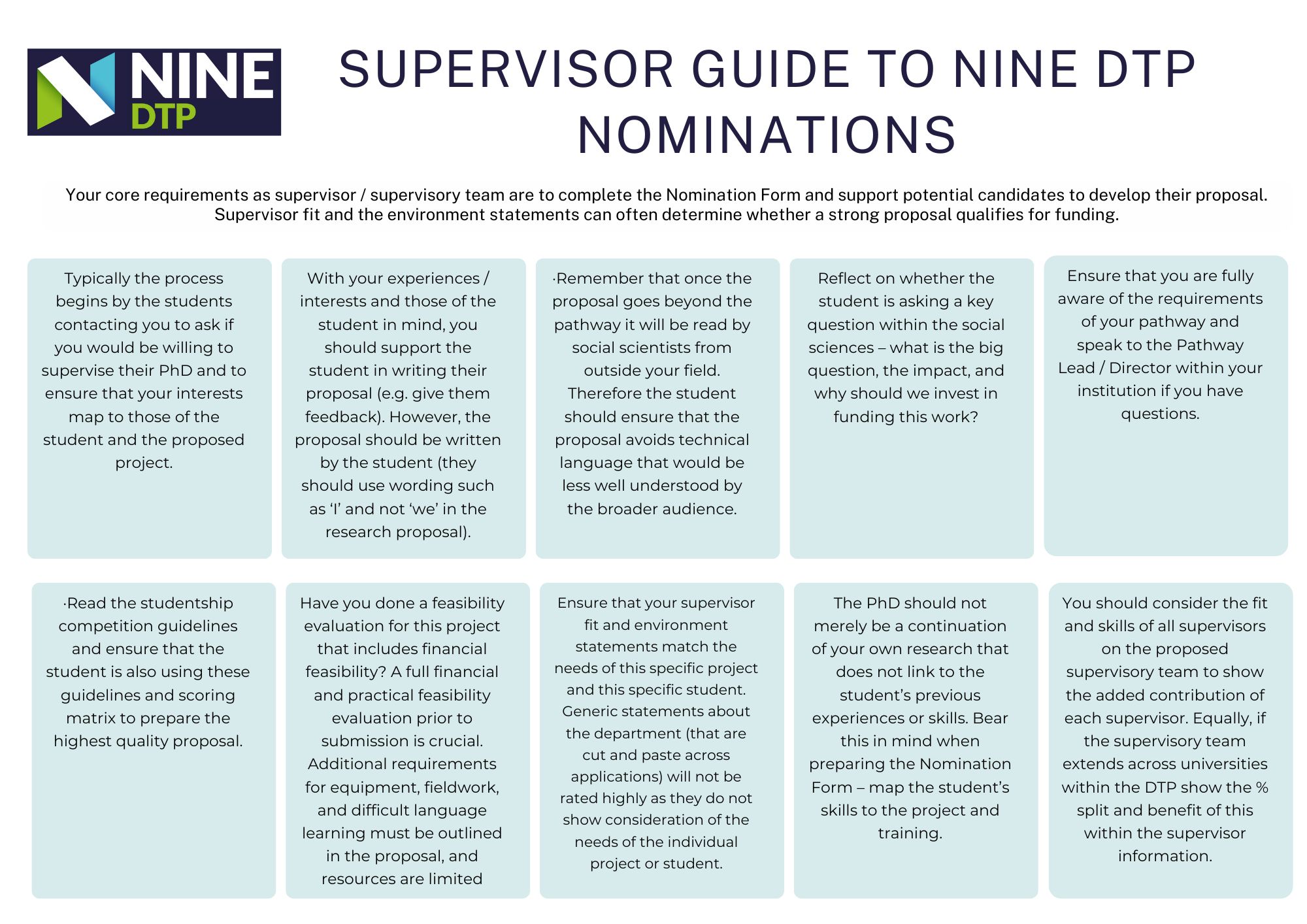
The NINE DTP application process requires collaboration between the candidate and their prospective supervisor. On the one hand, the heart of the application is the research proposal, which must be conceived and drafted by the student. Unlike in some competitions (and disciplines) where it is the norm for a supervisor to write the proposal and recruit a student to do the designated ‘work’, the research project at the core of a NINE DTP student’s training is meant to be student-led (although supervisors normally provide feedback as the candidate develops proposal drafts). Certain other aspects of the nomination file – letters of reference, transcripts, etc. – also typically are gathered by the candidate. The candidate also must apply to your institution for admission.
On the other hand, the nomination packet is to be compiled and submitted by you, the supervisor. Typically, the supervisor is in a better position than the candidate to complete certain aspects of the nomination form, such as the statements about the research environment and the proposed supervisory team. These and other ‘non-proposal’ elements of the nomination form do matter. Weak statements on these topics can disadvantage a nomination that otherwise would be competitive.
To assist you in working with a prospective student whom you are seeking to nominate for a NINE DTP studentship, we present the following timeline of the nomination process, as well as links to key documents and forms, and the recording of a webinar that NINE DTP Director Philip Steinberg led for prospective supervisors. In particular, we recommend referring to the NINE DTP Nomination Guidelines document for information about the nomination process as well as criteria for assessing nominations.
Who can supervise a NINE DTP postgraduate researcher?
All supervisors must:
- be demonstrably research-active and affiliated with a NINEDTP training pathway
- have a Doctoral degree or equivalent research/professional experience
- have completed mandatory training in Doctoral supervision
At least one member of the supervisory team:
- must have extensive experience of doctoral supervision with at least two successful PhD completions
We also extend opportunities for joint supervision to outstanding individual researchers in partner institutions who are not in eligible training pathways. In the case of collaborative research projects, supervisory teams are encouraged to include a third supervisor from the outside partner organisation, who would not be expected to meet usual requirements.
Team Supervison
Our team model:
- ensures that the doctoral researcher has access to at least one supervisor available at all times for the duration of the award.
- provides informal training to less-experienced supervisors who play an equal role in pastoral support and academic supervision, while the more experienced supervisor advises the student throughout, monitors their engagement with research training and alerts them to the full range of support services.
- allows for joint supervision enabling doctoral researchers to benefit from cross-institutional or cross-disciplinary expertise. Students are registered at a single University, where the first supervisor is based. Additional supervisors may be from other institution within or beyond the DTP, subject to university rules that may require two supervisors from the candidate’s home institution or department. Second and third supervisors are full members of the supervisory team, with agreed responsibilities and availability. NINE DTP encourages full workload recognition for all members of supervisory committees, regardless of whether the student is internal to their institution..
- builds capacity and extends good practice in supervision across the partnership.
- allows for external expertise to be included in project supervision.