
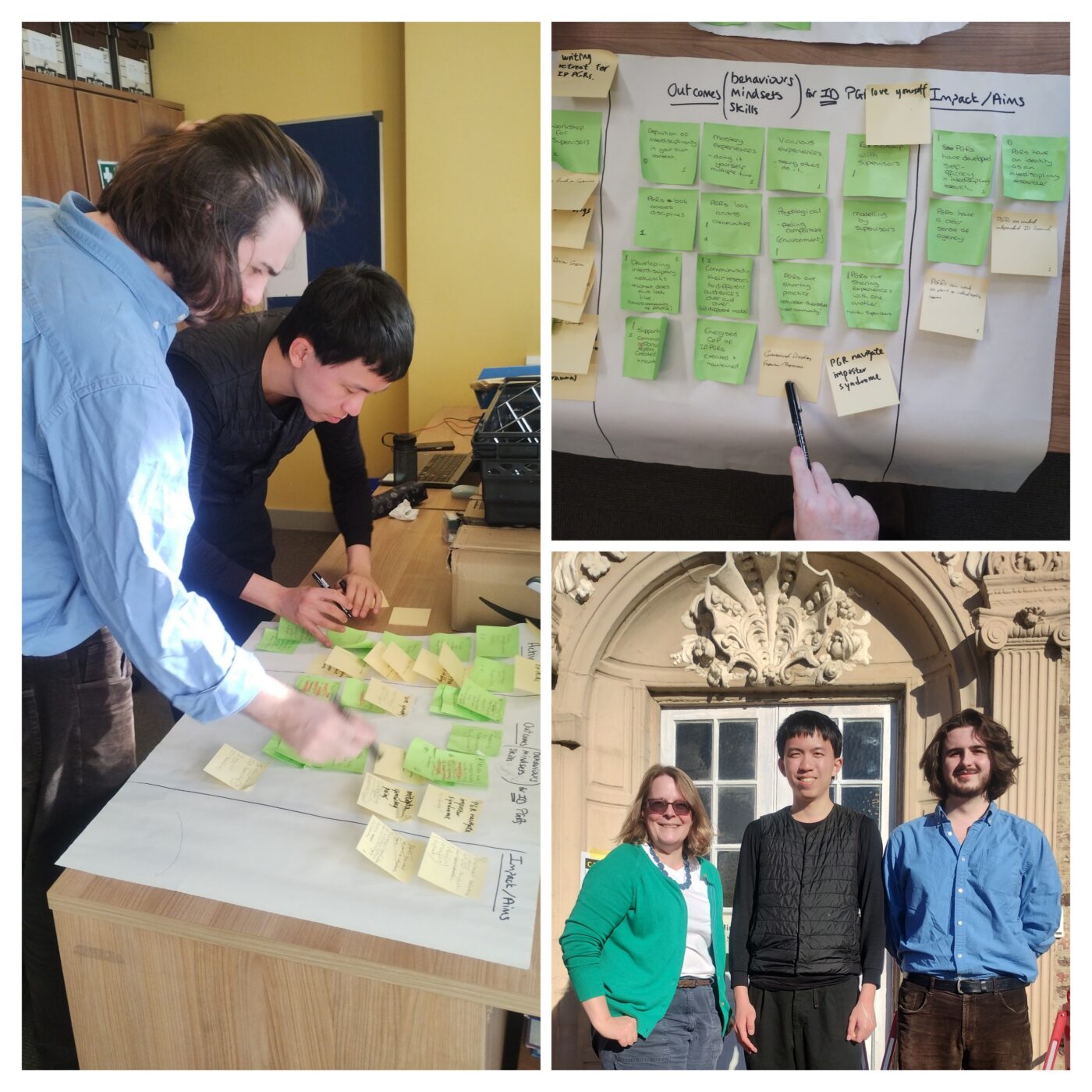
Following a competitive recruitment process, NINE-DTP PGRs Chung-Yen (Health Geography) and Zander (Anthropology) were appointed as Course Designers on an ESRC-funded collaborative project between NINE-DTP and Durham University’s Institute of Advanced Study to develop and offer training provision to enhance the interdisciplinary PhD student experience.
Interdisciplinary research is often characterised as the bringing together of themes, concepts, approaches and/or methods to apply them to problems or contexts which exist outside the scope of one disciplinary silo. Whilst rewarding, being an interdisciplinary PhD student requires a great deal of open-mindedness, flexibility, creativity and commitment to work across disciplines effectively and within interdisciplinary supervisory teams. Below, Zander and Chung-Yen share their experiences and what they took from working on the project.
Chung-Yen: We used a Theory of Change (ToC) approach (including SMART principles) to scope and design a workshop to support students at the start of an interdisciplinary PhD. It took more time than we imagined but resulted in us having clearer workshop aims, which in turn made it easier to identify learning outcomes and suitable workshop activities. It also helped us to better measure the effectiveness of the session – for example, we were able to claim we had met our aim of over 70% of participants feeling more confident of conducting interdisciplinary research by the end of the workshop. I find that the quantifiable result that ToC enables to be really helpful for demonstrating the effectiveness of my teaching skills and drew on my course design experience from the project as part of my successful 2025 Associate Fellow of the Higher Education Academy (AFHEA) application.
Zander: Theory of Change has also influenced my approach to session design. I’ve carried its principles into new projects such as offering training as part of co-supervision for an undergraduate summer internship. ToC gave me a strong starting point to identify my assumptions, to better position the training within the internship, and to make the design process both principled and efficient. Following a successful co-supervision experience, I have co-authored a paper with my UG intern and their other supervisor. The paper explores Early-Career Researchers’ experiences of participating in the UK Global Challenges Research Fund and is currently under a second round of peer-review by Parasitology.
Chung-Yen: Our project leader sought to create opportunities for us to co-design and co-lead the workshop, and in preparation, we also sought on student and supervisor perspectives and experiences through informal focus groups. I considered whether it would matter if I was swapped out for a post-doc/ staff member but I came to realise that my experience as an interdisciplinary PhD student and being closer to the student experience than staff gave me a unique position which helped me facilitate the student focus groups and to feed their and my own experiences into the workshop design and facilitation.
Zander: My lived experience as a student contributed to a more nuanced account of how to start an interdisciplinary PhD. At points I did feel nervous about co-leading a workshop and sharing my experiences with PhD students at a similar stage to me. After the session I realised that I needn’t have worried as people found it useful to hear about someone else’s experiences of PhD supervision and managing the ambiguity often found in interdisciplinary research. After the workshop, I’ve connected with several of the PhD student attendees and widened my interdisciplinary network.
Chung-Yen: I was excited to part of the project as getting the chance to be a course developer offered the chance to have more input into session design and was an opportunity most PhD students wouldn’t get the opportunity to do. To collaborate well as a team and with session contributors, we needed to follow each other’s pace. I really liked the Thinking Environment approach we used in meetings to help flatten the hierarchy, learn from each other and develop positive team dynamics. I felt we could talk freely about what was going on – positive or negative. Both Zander and I want to take that forward into our working practices.
Rosalind Beaumont (Project Lead, Institute of Advanced Study): Having interdisciplinary PhD students such as Chung-Yen and Zander actively collaborating with colleagues to scope, design and deliver training has been invaluable and central to ensuring that the provision offered has been relevant and accessible to this target student group. Being an interdisciplinary PhD student requires additional work across all aspects of their project, for example, to better understand how different research fields approach a given topic, or how to communicate interdisciplinary research effectively across academic disciplines and external audiences. With the ongoing increase in interdisciplinary research, it’s important that students (and their supervisors) are well supported as they navigate through their research and careers.
In addition to drawing on wider research and literature, Zander and Chung-Yen shared their personal insights and sought those of other students and supervisors to represent and integrate authentic and differing perspectives into the workshop, resulting with positive outcomes for the attendees. Both developed transferable skills around project and workshop planning & management, online and in-person facilitation skills, and evaluation strategies, which will serve them well as they progress through their doctorate and into their future careers.