
From 19 September – 19 December 2025, I embarked on an Overseas Institutional Visit (OIV) to Victoria University in Melbourne, Australia, in order to disseminate my findings and engage with the local scholarly community. I had also planned, given enough time, to incorporate a diaspora angle into my ongoing doctoral research on agrarian protest repertoires – in other words, I was hoping to find out whether mobilisation tactics and repertoires from the Irish countryside played a role in Australia.
Over the course of these three months, I managed to do a lot more than I set out to. I presented on five different occasions, in both academic and non-academic settings, including at VU’s postgraduate seminar, the Melbourne Irish Studies seminar, the Central Victorian Irish Association in Bendigo, the Melbourne Celtic Club, and the Irish Studies Association of Australia and New Zealand’s conference in Dunedin, New Zealand. From this broad engagement, multiple opportunities for collaboration, including a forthcoming podcast episode, have resulted.
I spent a lot of time in the local archives, namely the State Library of Victoria, the Public Records Office, and the Eureka Visitor Centre in Ballarat. In the former, I discovered a diary written by an Irish immigrant, John Joseph O’Meara, in the 1850s. The diary had never before come to scholarly or public attention and will be the focus of a forthcoming publication in the Australasian Journal of Irish Studies; I have also succeeded in making a digital copy of the diary publicly available. Two more publications, one of which I will put forward for the ISAANZ Postgraduate Essay Prize, are in the making thanks to the unexpected wealth of source material I discovered. The diaspora angle of my research has become much bigger than anticipated and the OIV turned out to be hugely beneficial for building my publication record, even if this was not the initial main goal. I was also able to meet with Elizabeth Malcolm, one of the foremost scholars of the Irish diaspora in Australia, and some ideas for a future joint publication emerged from the conversation.
I also taught on the local Irish History module at VU. Seeing an Australian perspective on Irish issues and being able to provide insight into the post-conflict society of Belfast was a very rewarding experience. Their mode of block tutorials – with a duration of 3 hours – is very different from the standard mode of teaching at Queen’s, and the intense engagement with primary sources that this allowed has given me opportunities to reflect on my own modes of tutorial delivery. I will certainly adjust some of the primary source exercises done there for my own use at QUB.
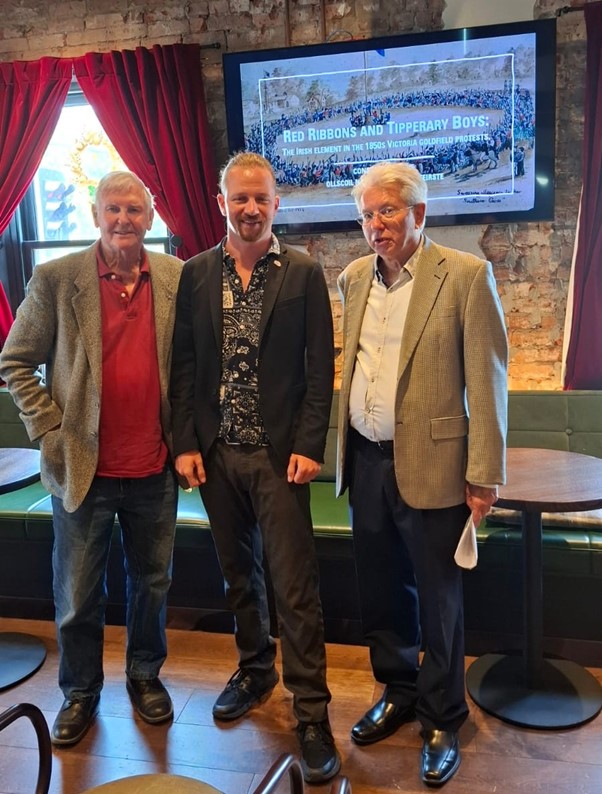
My advice for other NINE students undertaking an OIV would be – embrace the unexpected. As long as you can do so while meeting your core responsibilities towards your host institution, do not hesitate to go off on tangents, do some digging in the local archives, you never know what kind of connections to your ongoing research you might find. Also, do not neglect engaging with the broader local community outside the scholarly circles. Some of the best discussions, and collaboration opportunities, resulted from events with the Melbourne Celtic Club and Cumann Gaeilge na hAstráile. The synergy effects here were immense – finding local connections to my research resulted in more speaking opportunities which in turn resulted in more pointers towards relevant source material. Finally, do take some time off and explore the location of your OIV. I took a road trip across both islands of New Zealand (including a burglary attempt on my rental car by kea parrots) and returned to Belfast well rested and certainly a lot more sun-tanned than one would normally be this time of the year.
I would like to thank everyone at NINE and in Melbourne for funding and facilitating this OIV. Above all, Dianne Hall, for setting up everything on VU’s side, as well as providing excellent feedback, local advice, and support. Brent Biasin, for sharing his classroom and being an incredibly engaging and dedicated co-tutor. Elizabeth Malcolm, Val Noone, Malcolm Campbell, and Chris McConville, for discussions and very detailed feedback on various draft chapters. John Clancy and Peter Gavin for facilitating and hosting additional speaking opportunities. Naomi Harland and Aileen Carson for a smooth itinerary and prompt support from NINE regarding scheduling when I needed it. Finally, everyone at the Newman College Irish Library, the State Library of Victoria, the Linton Historical Society, and the Eureka Visitor Centre for supporting my research and accommodating a lot of last-minute requests.
Mise, le meas,
Constantin Torve
Economic and Social History pathway
Queen’s University Belfast